AI Overviews, answer engines, entity clarity, citations, and trust
AI SEO, AEO, and GEO for SaaS
AI search is not a shortcut around SEO. It raises the bar. If ChatGPT, Perplexity, Gemini, Google AI Overviews, and buyer-side research assistants cannot understand your entity, your expertise, your pages, and your proof, they will cite competitors who are easier to trust. Growth Fisher builds the content, structure, authority, and answer assets that make a SaaS brand easier to retrieve, evaluate, and cite.
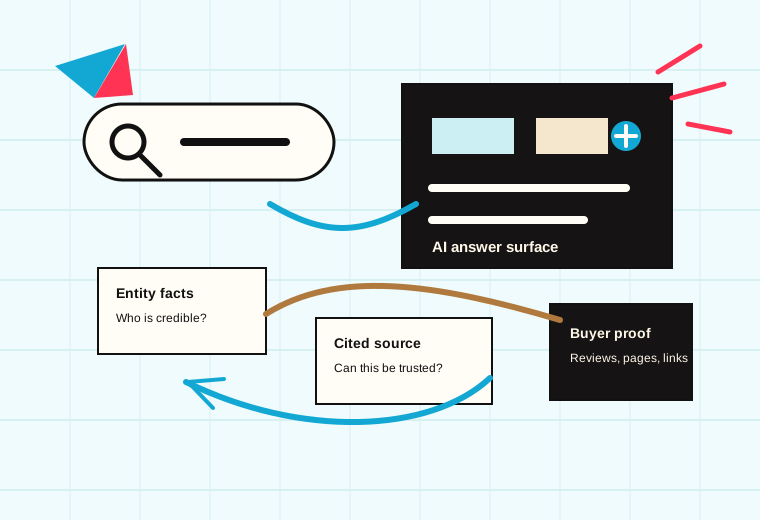
Work connected across the systems that shape this outcome
AI search diagnostic
Find where your brand is missing, misread, or under-cited in AI-assisted research.
The diagnostic checks how your category, product, authors, competitors, claims, and proof appear across answer engines, AI Overviews, and the pages those systems can use as sources.
Retrieval
Can AI systems find the right pages, entities, and evidence when buyers ask category and comparison questions?
Interpretation
Does the site make your positioning, audience, use cases, integrations, and proof unambiguous?
Citation
Are there enough credible, structured, specific assets worth quoting, summarizing, or recommending?
Where we usually begin
AI engines cite the clearest trusted source, not the loudest content calendar.
Your content answers topics, but not buyer questions.
AI systems need specific, well-structured answers that resolve how the buyer evaluates options, risk, fit, and proof.
The brand entity is hard for machines to pin down.
If your product, category, authors, claims, and third-party references are unclear, answer engines have less reason to associate you with the problem.
The site has pages, but few citation-worthy assets.
Thin explainers, generic lists, and vague claims are poor source material for AI answers and human evaluators.
AI visibility is measured like old traffic reporting.
Rankings and sessions do not explain whether the brand is appearing, being cited, or being framed correctly inside AI-assisted research.
Citation system
We turn scattered expertise into source material AI systems can understand and buyers can trust.
The work connects entity clarity, topical depth, content structure, author credibility, third-party signals, and conversion paths so AI visibility supports qualified demand instead of vanity mentions.
What we audit
AI visibility and entity review
AI Overviews, answer engine presence, brand association, author signals, product clarity, schema, and source quality.
Buyer-question coverage
Prompt themes, comparison questions, category education, alternatives, integrations, use cases, implementation concerns, and proof gaps.
Citation and trust signals
Claim specificity, direct answers, third-party references, reviews, links, author credibility, and evidence architecture.
What we fix
Make the entity easier to understand
Clarify brand, category, product, audience, use cases, and authorship across the pages answer engines use.
Create citation-ready pages
Improve pages so they answer concrete buyer questions with definitions, tradeoffs, examples, proof, and next steps.
Build measurement beyond rankings
Track answer presence, cited competitors, missing evidence, and whether AI visibility supports buyer movement.
What the client receives
An AI-search roadmap grounded in SEO fundamentals and buyer evaluation.
You get a practical plan for entity clarity, answer coverage, content gaps, structured data, proof, and monitoring.
AI visibility map
Where the brand appears, where it is absent, what competitors are cited for, and which buyer questions matter most.
Answer-ready content plan
Priority pages and updates for definitions, comparisons, use cases, alternatives, integrations, implementation, and proof.
Entity and citation action list
Schema, authorship, internal links, third-party proof, claim cleanup, and monitoring recommendations.
Scope
What we actually look at
The exact scope depends on the constraint, but this service usually covers these parts of the growth system.
Timeline
What the first 4-6 weeks look like
Week 1
Prompt and AI-answer sampling, entity review, search landscape review, source-page audit, and competitor citation scan.
Weeks 2-3
Buyer-question map, entity fixes, schema and content structure review, and priority answer-page recommendations.
Weeks 4-6
Page improvements, proof placement, internal-link updates, monitoring setup, and follow-up visibility review.
Fit check
When this is worth doing, and when it is not.
Worth a conversation
- Buyers use AI tools to research your category before contacting vendors.
- You have expertise and proof, but it is scattered across pages, decks, blogs, and sales conversations.
- You want AI visibility tied to evaluation and demand capture, not vague prompt-ranking claims.
Probably not the fix
- You want guaranteed AI citations or a shortcut that ignores SEO fundamentals.
- There is no subject-matter input, proof, or willingness to clarify claims.
- The only goal is traffic volume rather than buyer trust and evaluation.
AI SEO review
Want to know whether AI search can understand and cite you?
Share the category, priority products, competitors, pages, and AI-answer examples where your brand is missing or misrepresented.